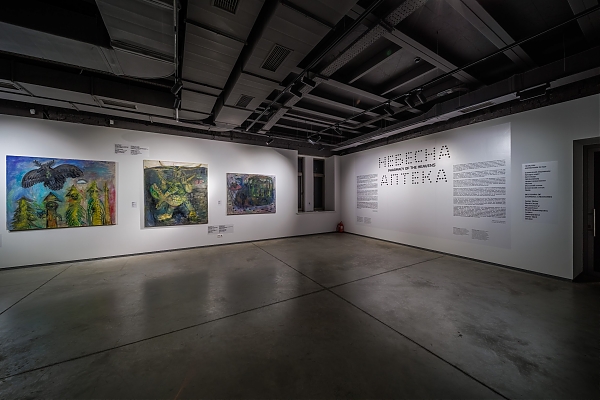
An exhibition about space — mythical, uncanny, and real. About its indivisibility and its many forms of manifestation. About movement and conscious action that change the way we perceive it. About healing trauma within the chaos and constant horror of contemporary life.
The project is the result of a collaboration between two artists from Dnipro. It began with the paintings and poetry of Volodymyr Gabuda, for which Oleksandr Suprun created a sound installation.

Dnipro is a city that has rapidly transformed — and continues to transform — its landscape, appearance, the very essence of its “places of power” (architectural structures, familiar locations), and even its toponymy (what things are called). This has taken on an additional dimension during the full-scale war due to Russian shelling and significant migration. What is the memory of Dnipro, and what is the memory about Dnipro? How are stories about people inseparably linked with stories about buildings, the embankment, shopping centres, cinemas, kindergartens, offices, sports institutions, and parks? How can one sense the pace of these shifts and the scale of the changes?

The exhibition marks Tatarczuk’s return to his personal artistic practice after many years of directing Galeria Labirynt in Lublin, a city that is 100 km from the Polish-Ukrainian border, where he focused on fostering the work of others. This experience deeply influenced his artistic language, shaping the key features of his practice: political awareness, attention to others, collaboration, and coexistence. A work which opens the exhibition — Moving Towards East — literally embodies both the political and artistic movement of the artist toward closeness with Ukrainian art, its support, and his continued presence within this cultural space.

The graphics presented in the exhibition retain traces of mold on themselves, as evidence of the literal fragility and distortion of memory, of destructive oblivion. The exhibition invites us to enter into a dialogue with the past: not to erase the difficult pages of history, not to cleanse it of pain, but to transform it into knowledge. True healing of memory is possible only when we allow ourselves to see it in its entirety — with difficult periods, uncomfortable memories, doubts, and losses. They become a resource: they help us understand the mechanisms of violence, mistakes, and destruction — and enable us to act differently.

At the core of the exhibition is the cycle Welcome to Paradise (2023 – 2024) — an attempt to analyze how pop culture creates illusions of ideal places through wallpaper, a popular element of interior design in post-Soviet homes of the late 1990s – 2000s. Such backdrops offered an affordable way to “zone” and decorate a room, to create a personal dream of “paradise.” Wallpapers with titles like Gardens of Eden or Heavenly Delight, and other variations of the word “paradise,” can still be found for sale today. In the series, artist oppose this imagined zone of comfort to the real experience of war. Onto these idealized images, scorched earth, ruined structures, and emptiness emerge.

Looking into the Gaps is an exhibition project in progress. The display, spanning the spaces of Artsvit Gallery and DCCC, continues the exhibition held at Voloshyn Gallery in Kyiv from June to July 2024. This planned exhibition cycle is dedicated to the theme of ruptures in linear historical narratives and the search for alternative connections that unite Ukrainian art into a shared field of experience. The central motif of the second chapter of the cycle is landscape, terrain, territory, and biotope. War, landscape, and art exist in this exhibition in a state of active interpenetration.

Lucy Ivanova’s major solo show was conceived as an attempt at a retrospective look at her practice before the full-scale invasion. It was meant to open on February 25, 2022, at the Artsvit Gallery in Dnipro — her hometown and the first milestone on her professional path. Three years later, the artist, with the Artsvit Gallery and curators Liza German and Maria Lanko, returns to the moment when the unopened exhibition collided with the full-scale war. This moment becomes a new starting point for narrating Lucy’s art across two periods.

World Press Photo Exhibition 2024 opens at Artsvit Gallery and Dnipro Center for Contemporary Culture on January 22nd, 2025. Presenting the results of the foundation’s annual photo contest, the World Press Photo Exhibition showcases the best photojournalism and documentary photography of 2023.
In total, 129 photographs will be presented, documenting the war, protests, migration and climate crises and other significant events of 2023. Finalists were chosen from over 61,000 works submitted by 3,851 participants from 130 countries worldwide. All photos are winners of regional competitions in the categories of "Long-Term Project” and "Open Format", as well as two special mentions.

Our educational art program “Artsvit for Kids” has come to an end! Its final was the opening of a collective exhibition of works created by children during the project!
This year's course was called “Theater Stories” — the children learned acting in its various manifestations: they learned to express their emotions with their bodies, work with associations, invent stage images and makeup, create sets and costumes, make their own puppets, and even put on shadow plays. In fact, in the exhibition we presented imaginary posters for plays and films, sketches of stage costumes, handmade scenery and puppets for the papet show, and a recording of two shadow performances that the children performed for the guests of the vernissage.

On November 30, we opened a pop-up exhibition based on the results of the Co-creation educational program for teenagers aged 14 to 17, which lasted for two months — from October to November 2024. The exhibition featured works created by the project participants during the workshops.

It all began with poet-painting — the futuristic poetry of Mykhailo Semenko. At the time, I was trying to unravel the poem “Village Landscape,” to hear and see what it meant for me. That’s how I started my own experiments, with the first rule being daily work.
What appeared was an art project, but it felt like I’d written a book. Only now, it was as if I had posed a riddle to myself. I gathered together familiar images of my homeland and spoke about them in a way I never had before — now I’m watching how they respond, waiting.
The new beginning changed the entire process. Fragments instead of a whole — this seems to be what my experiment is about.

I am tending my mother's garden: I help her with old cherry branches. Where there are no flowers or buds, cut them off. It used to hurt me to even watch someone pruning trees. I go to the greenhouse and pull up grass between the seedlings with my fingers. The earth gets stuck under my nails. I look at my palms and know for sure that they are dirty with soil. But my eyes see dried blood.
I remember the 'first' thunderstorm. How many new ‘first’ things have occurred since the beginning of the full-scale war? I looked out the window and saw May’s lightning. I knew for sure it would be followed by thunder. But my ears heard an explosion.
