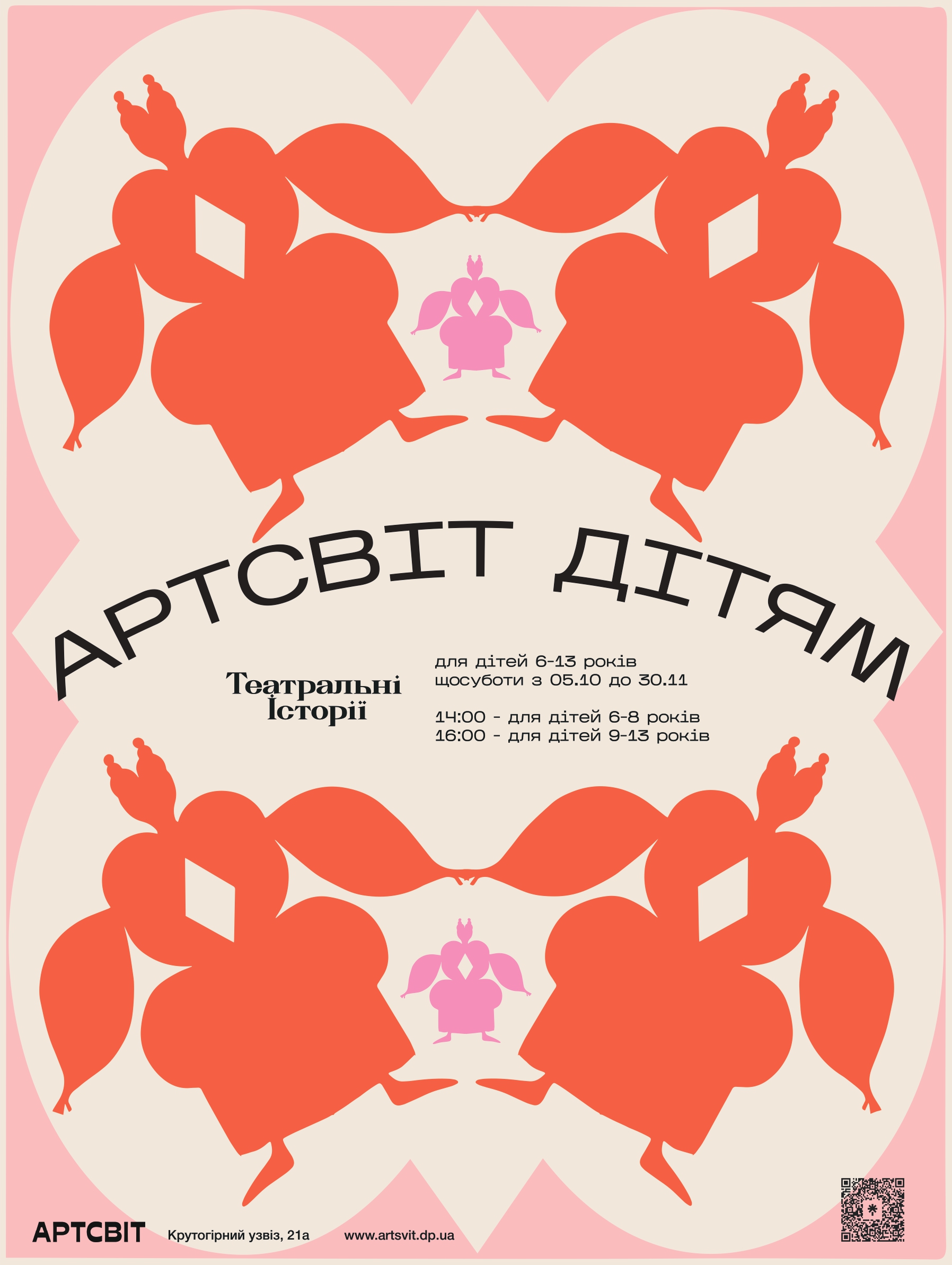
Finally, we are pleased to announce the launch of a new course in the Artsvit for Kids educational program, "Theater Stories". The project is dedicated to visual art, performance, and theater in particular.
By building a set using kraft paper, boxes and paints, or creating a puppet out of wool and fabrics, writing a script for a performance, applying makeup, designing props and costumes, children will become real puppet masters, decorators, costumers, directors, theater artists and engineers of their own stage.
This format gives children a wide field for experimentation and creative exploration: in addition to the usual practices of free movement, games and dance, we will learn the art of theater in many of its aspects and types: street theater, puppet and miniature theater, noh and kabuki theater, and a separate focus of the program will be shadow theater, the themes of light and darkness, good and evil. In addition, we will try to explore the history and development of theater through the centuries and how it affects us now.
The program starts on October 5. The course will consist of 9 lessons (every Saturday at 14:00 for children aged 6-8, at 16:00 for children aged 9-13) and will end with a joint public event in late fall.
The classes will be held at 21a Krutohirnyi Uzviz, Artsvit Gallery. Entrance through the glass sliding doors from the side of Uspenskaya Square.
Entrance is free.
Please note! To participate, you need to register for each class. Every week we will publish a new registration form for the next class, so stay tuned. Participation in the program is free.
Find links to new registrations here!
Authors and teachers of the program: Alina Stefan and Yulia Hryshyna
Project coordinators: Stanislav Pyvonos
Design: Olena Misyura
The educational platform "Artsvit for Kids" has been operating since 2014. Each of its iterations touches upon new topics and techniques, but one thing remains unchanged — the desire to open the multifaceted world of art to children and refute the idea that it is boring or difficult to understand. We are convinced that through creativity, children get to know themselves better and acquire a variety of skills that are useful in adulthood and in any profession, even technical ones.
However, we would like to emphasize that this project is not an academic education; our teachers do not teach children to draw. Communication is an important factor in the program, we want to integrate children and teenagers into the art community, to organize a dialogue, to refute the idea of art as something boring and difficult to understand. We believe that the younger generation deserves to have a broad outlook, and that art and culture in general not only enrich them aesthetically, but also educate them as conscious citizens.
We noticed that in their conversations, children often touch upon the topics of war, death, and the nuclear threat. At the beginning of the program in the fall of 2023, the teachers noticed detachment, aggression, withdrawal, and a preference for dark colors in the drawings. However, those children who regularly attended classes became more proactive, involved in the process, and interacted more actively with others in the team.
We will continue to create a safe and supportive environment at the Artsvit Gallery where children can express their emotions, relieve stress and develop their creativity. Through art classes, we help children overcome the traumatic experience of war and contribute to their social and emotional rehabilitation, as well as give them creative tools to understand the world and themselves.
Teacher Alina Stefan: “I see how important it is for parents to take their children to art events, and their efforts to keep their children in the normal world of childhood even in the middle of a war when reality is collapsing. At first I thought, what can art do when people are dying, artillery and rockets are destroying towns and villages, people are losing the most basic necessities and don't feel safe? Now I have realized that my experience as a children's writer, my experience as a teacher, my experience as a doctor — all of these things help a lot — they give rise to strength, and I can help children, adults, wounded soldiers, and I am learning to do it better with every meeting, with every group, every participant, and now I see how important it is here in Dnipro. I see people smiling at their own or their children's artistic achievements, wrinkles between their eyebrows smoothing out, and them becoming a little less tense at an exhibition of their children's drawings. I see how children calm down and become less anxious when they hold a paint brush, plasticine, cardboard, or oil crayons. I see how art pulls out those who are “drowning” in the daily trauma of loss, when yesterday you bought markers in a store and today it was destroyed by an explosion. And children drive by and see their daily lives being destroyed every day. And then in the classroom in the shelter, they draw, cut out, do shadow theater or make up a fairy tale and create art and life out of the rubble they just drove by. I want the world to hear the voices of these children.”